
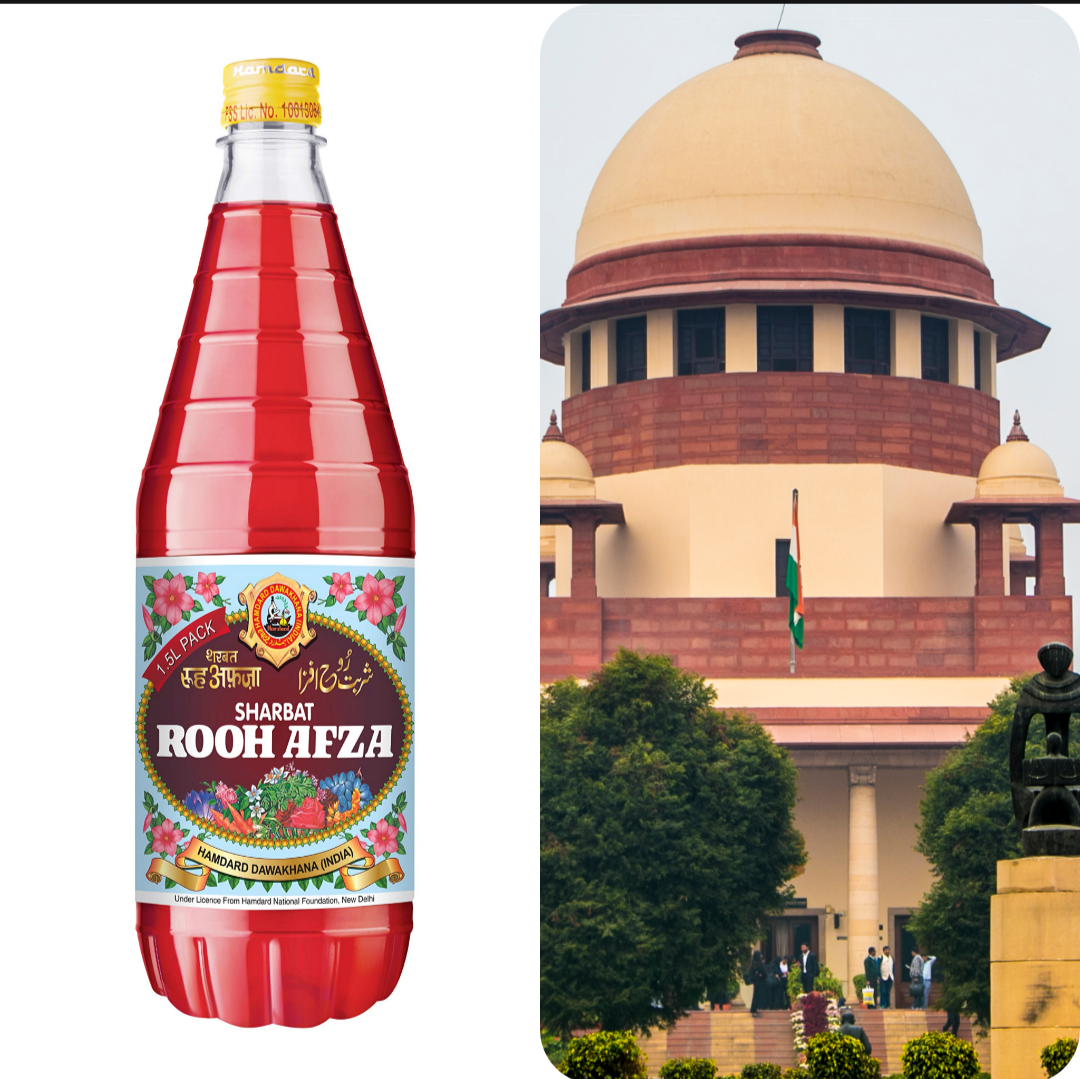
Case: M/s. Hamdard (Wakf) Laboratories v. Commissioner of Commercial Tax
Court: Supreme Court of India
Case No.: SLP (C) 6074–6095 / 2019
Judgment Date: 25 February 2026
Historical Background
The dispute originated when tax authorities classified Rooh Afza syrup as an “unclassified item” under the U.P. VAT regime.
Unclassified goods attracted 12.5% VAT, while fruit drinks/processed fruit products were taxed at 4%.
The manufacturer argued that the product contains fruit extracts and therefore qualifies as a fruit-based beverage concentrate.
Tax authorities treated it as a generic syrup, not a fruit product, and imposed higher tax.
The matter went through adjudication authorities and appellate tax tribunals before reaching the Supreme Court.
Current legal Development (2026 judgement)
The Supreme Court held:
The product must be classified as a fruit drink / processed fruit product.
It should be taxed at 4%, not 12.5%.
Classification must depend on:
Ingredients
Common commercial understanding.
Functional character of the product .
The Court rejected the department’s narrow interpretation that it was merely a syrup.
Judiciary Aspirants Golden Rule Analysis
1. Constitutional Provision Involved
Though the dispute is statutory, constitutional principles arise indirectly:
Article 265 — No tax shall be levied or collected except by authority of law.
Article 14 — Tax classification must not be arbitrary.
Article 19(1)(g) — Excessive or wrongful tax classification can affect business freedom.
Relevant Act and Sections
U.P. Value Added Tax Act, 2008
Key issue: Schedule classification entry
Legal question:
Which schedule entry correctly covers the product?
Tax statutes typically classify goods into:
specific entries
residual entries
Rule:
Specific entry prevails over residuary entry.
Precedents / Case Law Principles Used by courts
Indian courts have repeatedly held in classification disputes:
Common Parlance Test :
Goods must be classified as understood in the market, not by technical definition.
Functional test :
Use and purpose determine classification.
Specific vs Residual Entry Rule :
If a product reasonably fits a specific category, it cannot be pushed into a general category for higher tax.
These doctrines have been reaffirmed in multiple indirect tax judgments across VAT, Excise, and GST regimes.
Core Legal Principles Established
Substance over Label :
Authorities cannot rely only on product description; composition matters.
Beneficial Classification Rule :
If ambiguity exists, interpretation should favour the assessee in taxation statutes.
Strict Interpretation of Tax Laws :
Revenue authorities cannot extend tax liability by analogy.
In tax classification disputes, courts apply the common parlance test + specific entry rule + strict interpretation principle, favouring the taxpayer where ambiguity exists.