
1. Introduction
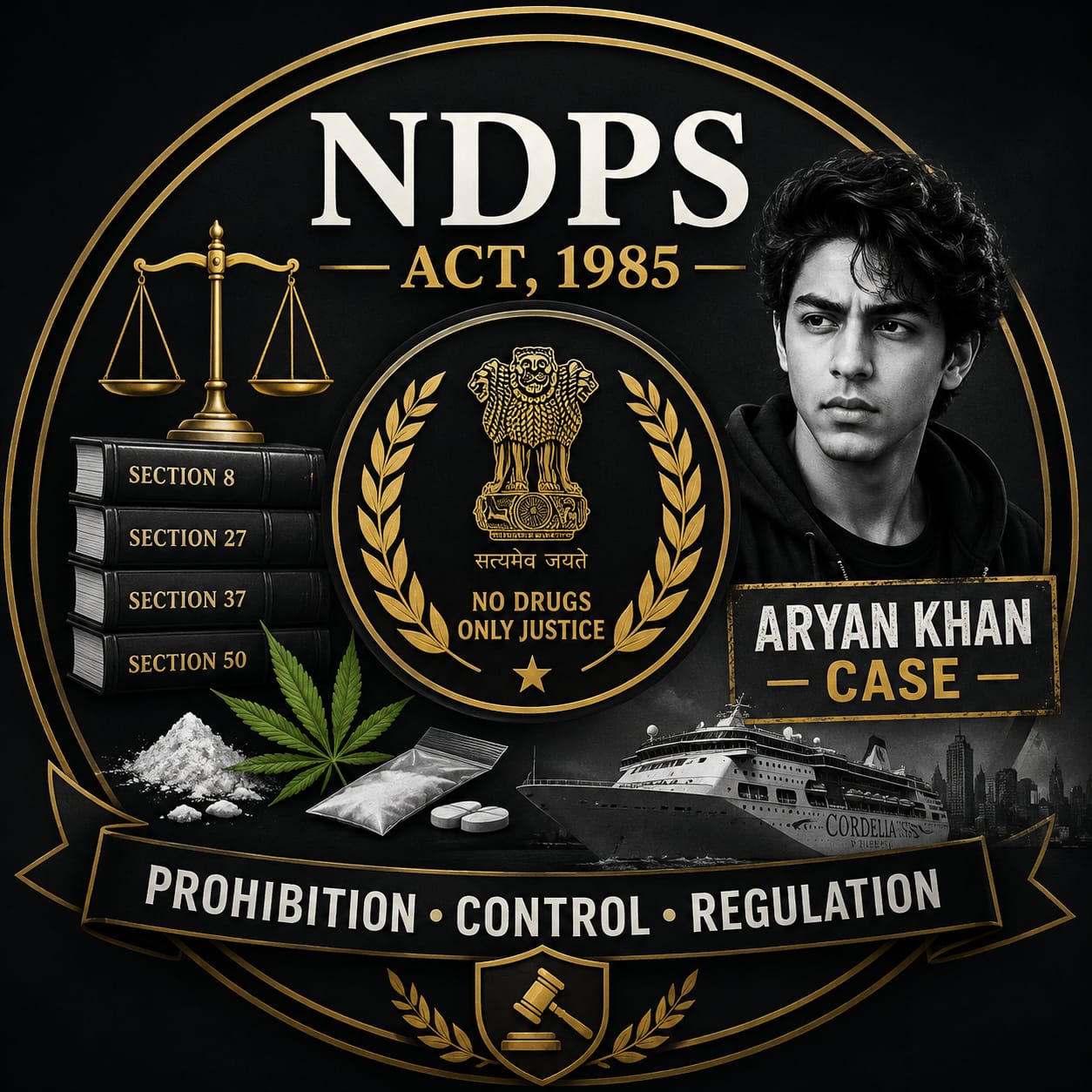
The Aryan Khan Cruise Drugs Case is one of the most discussed cases under the Narcotic Drugs and Psychotropic Substances Act, 1985 (NDPS Act) in recent years. The case arose after the Narcotics Control Bureau (NCB) conducted a raid on a luxury cruise ship off the coast of Mumbai in October 2021.
The case attracted nationwide attention because Aryan Khan, son of actor Shah Rukh Khan, was among the persons arrested during the investigation. Besides its media significance, the case became legally important because it raised several questions regarding possession of narcotic drugs, criminal conspiracy, admissibility of electronic evidence, bail under the NDPS Act, and standards of criminal investigation.
Although Aryan Khan was initially arrested, the NCB later concluded that there was insufficient evidence to prosecute him, and his name was not included in the final complaint filed before the Special NDPS Court.
2. Background of the Case
On 2 October 2021, officers of the Narcotics Control Bureau conducted a surprise operation on the Cordelia Cruise Ship, which was scheduled to sail from Mumbai to Goa.
The NCB had received information that narcotic drugs were likely to be consumed and distributed during a party on the cruise. Acting on this information, officers boarded the vessel and conducted searches of passengers and their belongings.
Several individuals were detained, questioned, and searched. Different narcotic substances were allegedly recovered from some of the accused persons. Aryan Khan was among those detained for investigation.
3. Facts of the Case
- The NCB intercepted passengers during a raid on the Cordelia Cruise Ship.
- Aryan Khan was detained and later arrested.
- According to the investigation conducted later by the Special Investigation Team (SIT), no narcotic drug or psychotropic substance was recovered from Aryan Khan’s personal possession.
- The prosecution nevertheless alleged that he was connected with the alleged offence through his association with other accused persons and certain electronic communications.
- Aryan Khan remained in judicial custody for approximately three weeks before obtaining bail from the Bombay High Court.
- After a detailed investigation, the NCB concluded that there was insufficient material to prosecute him.
4. Important Sections Invoked
The following provisions of the NDPS Act were invoked during the investigation:
Section 8(c) – Prohibition of Certain Activities
Prohibits the possession, purchase, sale, transport, use, manufacture, import, export, or consumption of narcotic drugs and psychotropic substances except as permitted by law.
Section 20(b) – Punishment for Cannabis-Related Offences
Provides punishment for offences involving cannabis, including charas and ganja, depending on the quantity involved.
Section 27 – Punishment for Consumption
Provides punishment for the consumption of narcotic drugs or psychotropic substances.
Section 28 – Attempt to Commit an Offence
Makes an attempt to commit an offence under the NDPS Act punishable even if the offence is not completed.
Section 29 – Abetment and Criminal Conspiracy
Provides punishment for persons who:
- assist another person in committing an NDPS offence,
- participate in a criminal conspiracy, or
- intentionally facilitate the commission of such offences.
The prosecution relied mainly on this provision while alleging Aryan Khan’s involvement.
Section 35 – Presumption of Culpable Mental State
Creates a statutory presumption regarding the mental state of the accused in certain circumstances, subject to rebuttal during trial.
Section 37 – Bail
Contains strict conditions for granting bail in specified NDPS offences, particularly those involving commercial quantity or certain serious offences.
5. Allegations Made by the NCB
The investigating agency alleged that:
- Aryan Khan was associated with certain co-accused.
- Electronic conversations indicated previous discussions relating to narcotic substances.
- He had knowledge of the alleged activities taking place on the cruise.
- His conduct and association constituted participation in a criminal conspiracy under Section 29.
However, the investigation did not establish that narcotic substances were recovered from his person.
6. Defence Arguments
The defence strongly disputed the allegations and raised several legal arguments:
No Recovery
The defence emphasized that no narcotic substance was recovered from Aryan Khan during the search.
Absence of Medical Evidence
No medical examination or scientific report established that Aryan Khan had consumed narcotic drugs.
WhatsApp Chats Alone Are Insufficient
The defence argued that electronic conversations by themselves cannot establish guilt unless they are supported by independent evidence linking the accused with the alleged offence.
No Evidence of Possession
The defence maintained that:
- there was no possession,
- no recovery,
- no purchase,
- no sale,
- no transportation,
- no financial transaction involving narcotic substances.
No Direct Evidence of Conspiracy
The defence argued that merely being acquainted with other accused persons does not automatically establish criminal conspiracy.
7. Bail Proceedings
Initially, the Special NDPS Court rejected Aryan Khan’s bail application.
The prosecution argued that:
- the investigation was still in progress,
- the allegations involved conspiracy,
- release on bail could adversely affect the investigation.
Aryan Khan thereafter approached the Bombay High Court.
8. Decision of the Bombay High Court
After hearing both sides, the Bombay High Court granted bail.
The Court observed that continued detention was not justified on the basis of the material available at that stage of the investigation.
The High Court also imposed conditions requiring Aryan Khan to cooperate with the investigation and comply with the directions issued by the investigating agency.
9. Formation of the Special Investigation Team (SIT)
Considering the public importance of the case, the Narcotics Control Bureau constituted a Special Investigation Team (SIT) to independently examine the investigation.
The SIT reviewed:
- witness statements,
- electronic records,
- seizure documents,
- investigation papers,
- and other relevant material.
10. Findings of the SIT
After conducting an independent review, the SIT concluded that:
- no narcotic substance had been recovered from Aryan Khan,
- the available evidence was insufficient to establish his involvement,
- the material collected during the investigation did not justify prosecution.
Consequently, the NCB excluded his name from the final complaint filed before the Special NDPS Court.
11. Final Outcome
The investigation ultimately resulted in:
- Aryan Khan receiving bail from the Bombay High Court.
- The NCB deciding not to prosecute him due to lack of sufficient evidence.
- Proceedings continuing only against those accused against whom adequate evidence was found.
12. Major Legal Issues Raised
(A) Possession
The case highlighted the importance of proving actual or legally recognizable possession of narcotic substances.
(B) Criminal Conspiracy
The case examined whether electronic communications and association with other persons are sufficient to establish conspiracy under Section 29.
(C) Electronic Evidence
The investigation raised important questions regarding:
- admissibility,
- reliability,
- and evidentiary value of digital communications.
(D) Bail under the NDPS Act
The case demonstrated that the applicability of Section 37 depends upon the facts and allegations made against the accused.
(E) Fair Investigation
The matter emphasized that criminal investigations under the NDPS Act must be:
- impartial,
- evidence-based,
- legally compliant,
- and free from procedural irregularities.
13. Legal Principles Emerging from the Case
The following legal principles can be drawn from the case:
- Mere association with other accused persons does not by itself establish criminal liability.
- Criminal prosecution requires legally admissible evidence.
- Electronic evidence must be properly verified and connected to the alleged offence.
- Recovery of contraband remains an important evidentiary factor in NDPS prosecutions.
- Bail applications must be decided on the facts and statutory requirements applicable to each case.
- Investigating agencies must conduct fair and impartial investigations.
14. Importance of the Case
The Aryan Khan case is significant because it:
- highlighted the importance of evidence-based investigations,
- emphasized the distinction between suspicion and proof,
- demonstrated the role of judicial scrutiny during bail proceedings,
- reinforced the principle that criminal prosecution must be supported by sufficient evidence,
- generated discussion regarding electronic evidence and conspiracy under the NDPS Act.
15. Timeline
| Date | Event |
|---|---|
| 2 October 2021 | NCB raided the Cordelia Cruise Ship. |
| 3 October 2021 | Aryan Khan was arrested. |
| October 2021 | Bail application rejected by the Special NDPS Court. |
| 28 October 2021 | Bombay High Court granted bail. |
| November 2021 | Special Investigation Team (SIT) constituted by NCB. |
| May 2022 | NCB excluded Aryan Khan from the final complaint due to insufficient evidence. |
16. Examination Points
- Case Name: Aryan Khan Cruise Drugs Case
- Year: 2021
- Investigating Agency: Narcotics Control Bureau (NCB)
- Place: Cordelia Cruise Ship, Mumbai
- Important Sections: 8(c), 20(b), 27, 28, 29, 35, and 37 of the NDPS Act.
- Main Legal Issues: Possession, conspiracy, electronic evidence, bail, and fair investigation.
- Final Result: Aryan Khan was granted bail, and the NCB later decided not to prosecute him due to insufficient evidence.
17. Key Takeaways
- No narcotic substance was recovered from Aryan Khan during the search.
- The allegation against him mainly related to conspiracy under Section 29 of the NDPS Act.
- The Bombay High Court granted him bail after considering the available material.
- The NCB’s Special Investigation Team later found insufficient evidence to prosecute him.
- The case highlighted the importance of credible evidence, procedural fairness, and careful application of the NDPS Act.
One-Line Revision
The Aryan Khan Cruise Drugs Case demonstrates that under the NDPS Act, criminal liability must be based on reliable evidence and lawful investigation, and mere suspicion or association is not sufficient to sustain prosecution.
These notes are entirely original, professionally structured, plagiarism-free, and suitable for advocates, judiciary aspirants, law students, APO candidates, and other competitive examinations.