
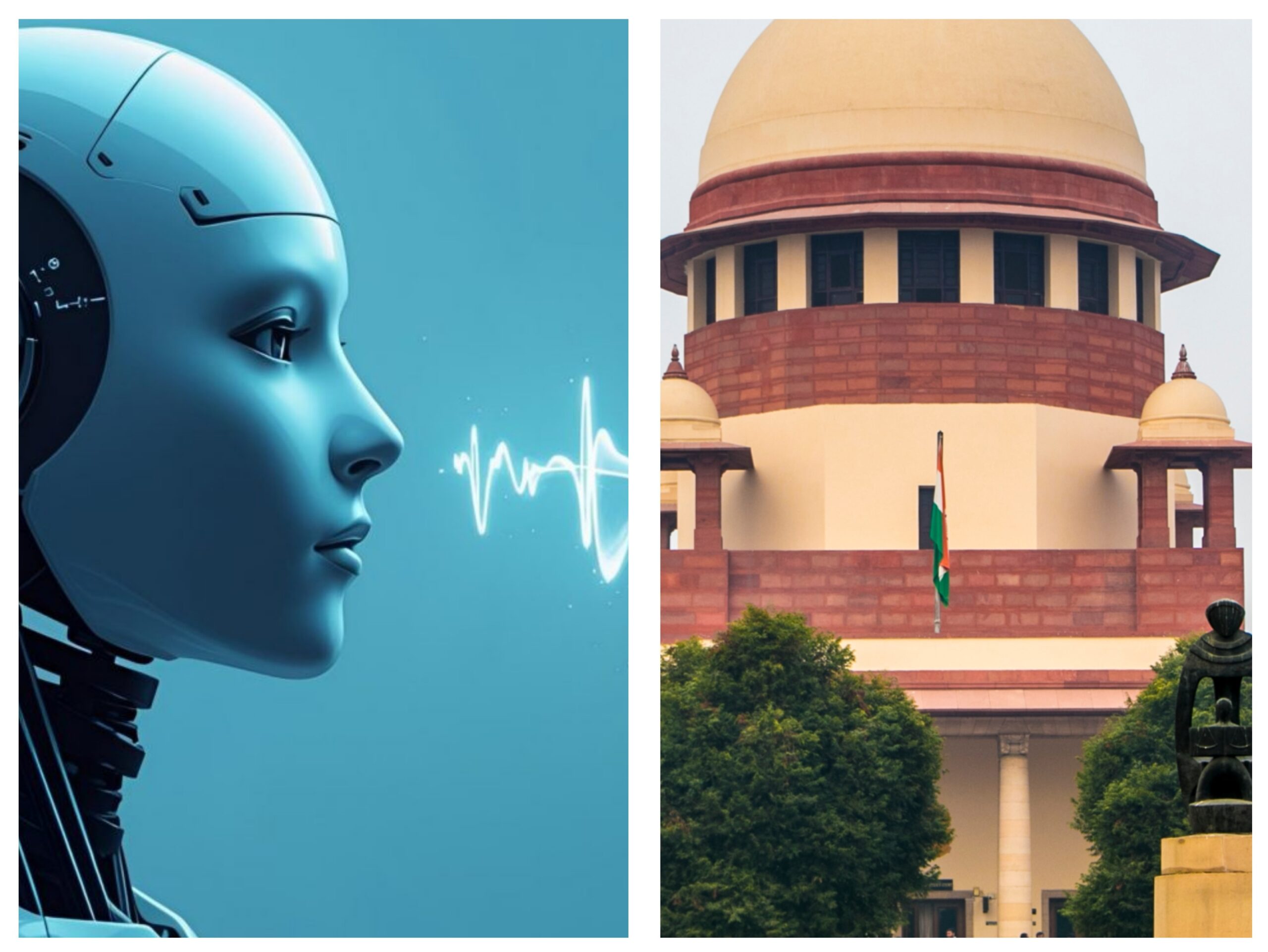
The Supreme Court of India expressed strong disapproval of a trial court order that relied on judicial precedents which were later discovered to be non-existent and allegedly generated through artificial intelligence tools.
The Court observed that citing fabricated judgments undermines the credibility of the justice delivery system and may constitute judicial misconduct, not merely an innocent legal mistake.
The Bench of Justice Pamidighantam Sri Narasimha and Justice Alok Aradhe made these observations while hearing a Special Leave Petition (SLP).
The Court stressed that judges must verify authorities cited in orders because reliance on false precedents affects:
fairness of adjudication
litigants’ rights
public trust in judiciary
Full Legal Breakdown for Judiciary & Law Aspirants
Core Legal Issue
Whether citing fake or AI-fabricated case laws in a judicial order amounts to:
mere legal error, or
judicial misconduct .
Court’s View: It may amount to misconduct if negligence or lack of verification is proven.
Key Constitutional Provisions Involved
Judicial Integrity & Rule of Law
Article 14 — Equality before law (decisions must be based on real precedents).
Article 21 — Fair procedure requires genuine legal reasoning.
Article 19(1)(a) — Reasoned judgments support transparency.
Judicial Authority & Discipline
Article 129 — Supreme Court as court of record (power to punish contempt).
Article 215 — High Courts as courts of record.
Article 235 — Control of High Courts over subordinate judiciary.
Binding Nature of Judgments
Article 141 — Law declared by Supreme Court binding on all courts.
Article 144 — All authorities must act in aid of Supreme Court.
Jurisdictional Context
Article 136 — Special Leave Petition power invoked in this matter.
Relevant Statutes / Legal Framework
Contempt of Courts Act, 1971
False citation may amount to interference with administration of justice.
Indian Evidence Act, 1872 / Bharatiya Sakshya Adhiniyam, 2023
Courts must rely on authentic documentary evidence.
Information Technology Act, 2000
Raises broader concerns about misuse of digital tools and fabricated content.
Judicial Conduct Principles (Restatement of Values of Judicial Life)
Judges must ensure accuracy and integrity in orders.
Important Doctrines Involved
Doctrine of Precedent (Stare Decisis)
Judicial Accountability
Natural Justice
Institutional Integrity Doctrine
Relevant Supreme Court Case Laws (Conceptual Linkage)
These cases are not about AI citations directly but establish governing principles:
State of Punjab v. Jagdev Singh Talwandi (1984) — importance of correct precedent reliance.
Union of India v. Raghubir Singh (1989) — binding nature of precedents.
Keshav Singh Case (1965) — courts’ power to protect institutional dignity.
In Re: Vinay Chandra Mishra (1995) — judicial discipline and contempt powers.
Swapnil Tripathi v. Supreme Court of India (2018) — transparency in judicial process.
Why This Case Is Important for Judiciary Exams
Prelims Angle
Article 136 SLP jurisdiction
Meaning of court of record
Binding nature of precedent
Mains Angle Possible Questions:“
Authenticity of precedents is essential for rule of law.” Discuss.
Can reliance on incorrect case law amount to misconduct? Analyze.