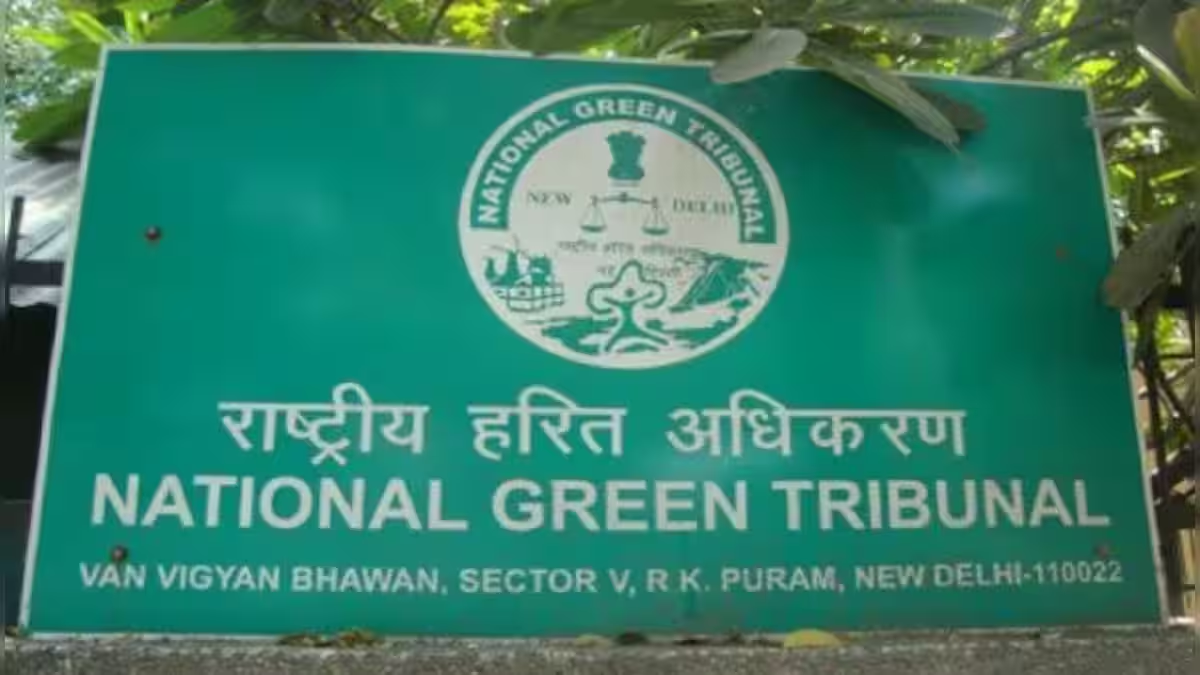
The National Green Tribunal recently dealt with a case involving industrial and infrastructure projects beginning preliminary work before receiving final environmental clearance.
The core issue:
Can a project start land clearing, construction, or preparatory activity without complete Environmental Clearance (EC)?
This question lies at the intersection of:
- Environmental law
- Sustainable development
- Administrative accountability
- Public interest litigation
Legal Background
Environmental Clearances in India are governed under the:
- Environment (Protection) Act, 1986
- EIA Notification framework (issued under the Act)
Before major projects (mining, highways, thermal plants, large real estate developments) begin, they must undergo:
- Environmental Impact Assessment (EIA)
- Public consultation
- Expert appraisal
- Government approval
What Was the Dispute?
In several cases across states, project authorities began:
- Site preparation
- Tree cutting
- Earthwork
- Boundary construction
before receiving final clearance.
Petitioners argued this defeats the purpose of environmental safeguards.
Tribunal’s Key Observations
The NGT emphasized:
- Environmental clearance must be prior and not post-facto.
- Starting work without approval violates precautionary principles.
- Economic development cannot override environmental compliance.
The Tribunal reiterated that “prior approval” is mandatory, not procedural formality.
Principles Reinforced
1. Precautionary Principle
If environmental damage is possible, preventive steps must be taken even if scientific certainty is incomplete.
2. Sustainable Development
Development must balance economic growth with environmental protection.
3. Polluter Pays Principle
If environmental harm occurs, the responsible party must compensate.
Why This Matters
1. Governance Accountability
Authorities cannot regularize illegal projects later.
2. Environmental Protection
Prevents irreversible ecological damage.
3. UPSC Relevance
Important for:
- GS Paper III (Environment & Ecology)
- Disaster management
- Sustainable development goals
- Environmental governance
Possible Mains angle:
“Evaluate the role of quasi-judicial bodies like the National Green Tribunal in strengthening environmental governance in India.”
Critical Angle (Don’t Ignore This)
There’s an ongoing tension:
- Developers argue delays hurt economic growth.
- Environmentalists argue lax enforcement causes irreversible damage.
The real issue isn’t development vs environment —
it’s whether regulatory systems are transparent, scientific, and timely.
If clearances were faster but stricter, litigation would reduce.
Conclusion
The National Green Tribunal continues to reinforce that environmental compliance is not optional. Projects must follow statutory procedures before beginning operations.
For civil services aspirants and law students, this highlights how environmental law functions as a tool of governance — not just conservation.